From SEO to GEO: Navigating the Unstable World of AI Search Results


Before we dive into the data, let’s define the shift. We are moving from the era of SEO (Search Engine Optimisation) to GEO (Generative Engine Optimisation).
While SEO focuses on ranking your website on a results page like Google, GEO is the process of optimising your brand’s presence so that AI models like ChatGPT, Claude, and Google Gemini
The New Playbook: Same Names, Different Game
If you spend five minutes in the GEO space right now, you’ll hear a familiar rhythm: track your prompts, measure your visibility, and optimise for AI citations.
It sounds nearly identical to the early SEO playbooks that helped build the modern web. But there’s a significant catch – the data behind these recommendations isn’t solid enough to build a reliable, long-term strategy on yet.
GEO isn’t something to ignore, but it’s also not something to approach blindly. The real challenge is knowing how to move forward while the measurement tools are still catching up to the technology.
The Problem: GEO Data Looks Precise But It Isn’t
When you use a GEO tracking platform, the metrics feel reassuringly concrete. You see prompt volumes, rankings, and “share of voice” scores. They look like SEO metrics. They behave like SEO metrics.
But they aren’t.
Unlike traditional search, there is no “clean” dataset of what people are asking AI tools. There is no AI equivalent of Google Search Console – no definitive source of truth from the platforms themselves. Instead, most GEO data today is built on:
- Estimates – educated guesses based on limited data sets.
- Panel Data – small groups of users whose behavior may not represent the whole.
- Simulated API Prompts – using software to “mimic” human questions.
This data isn’t useless – it’s excellent for seeing trends. But it is directional, not definitive.
The Research: AI Results are Fluid
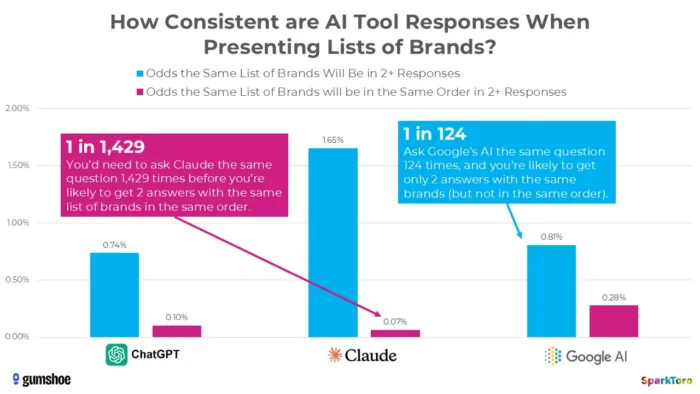
One of the most important studies in this space comes from Rand Fishkin and SparkToro (in collaboration with Gumshoe.ai).
They tested:
- 2,961 prompts
- Across 600 users
- On tools like ChatGPT, Claude, and Google AI
What they found:
- Less than a 1% chance of seeing the same brand list twice
- Less than a 0.1% chance of seeing the same list in the same order
In the world of AI, the concept of a stable “Position #1” simply doesn’t exist.
Probability vs. Precision
AI outputs change frequently, even when the prompt stays the same. This isn’t a bug – it’s a core feature of how Large Language Models (LLMs) work. They are probabilistic, not deterministic. They are designed to “predict” the next best word, which naturally leads to variation.
Any attempt to measure GEO with the same rigid precision as SEO will inevitably fall short. For now, the winning strategy isn’t about chasing a single ranking; it’s about building a digital footprint so authoritative that the AI’s “probability” of mentioning you becomes an inevitability.
The “rules” of AI search are being written in real-time, and we’re helping our clients stay ahead of the curve without falling for the hype. If you’re wondering how GEO fits into your 2026 marketing strategy, book a call with our dental marketing experts.
More posts from our team
Five Star
Reviewed Marketing



 "Would definitely recommend to a friend"
"I cannot recommend Dental Design highly enough"
"Really great company to deal with"
"Very professional, efficient & adaptive to new situations"
"I cannot recommend them highly enough"
"Has been invaluable and gone out of her way to help us"
"We love the look of our practice website. Very professional!"
"Dental Design stood out both in their knowledge of the industry and their professionalism"
"The team and package offered at dental design was unrivalled"
"absolutely fantastic and are always on hand to help"
"Dental Design are fantastic to work with"
"always met with a swift and professional response"
"Would definitely recommend to a friend"
"I cannot recommend Dental Design highly enough"
"Really great company to deal with"
"Very professional, efficient & adaptive to new situations"
"I cannot recommend them highly enough"
"Has been invaluable and gone out of her way to help us"
"We love the look of our practice website. Very professional!"
"Dental Design stood out both in their knowledge of the industry and their professionalism"
"The team and package offered at dental design was unrivalled"
"absolutely fantastic and are always on hand to help"
"Dental Design are fantastic to work with"
"always met with a swift and professional response"

